14.3 billion Lichess rating updates in one leaderboard
A leaderboard benchmark is easy to make synthetic: invent a few million users, assign random scores, and time the inserts. This is not that benchmark. This is nearly thirteen years of people playing chess.
Lichess publishes its game database as an open, CC0-licensed archive. The standard-chess records include the date, both players, and their Glicko2 ratings. We read those records in chronological order, from December 31, 2012 through September 30, 2025, and turned every valid player rating into the Redis operation it naturally represents:
ZADD leaderboard <rating> <player>Each rated game contributes up to two observations, one for White and one for Black. A regular player therefore appears over and over as their rating changes; a newcomer inserts a new member; an inactive player remains in the set at their last observed rating. By the end, the trace contains roughly 14.3 billion rating updates across 21,598,007 distinct players, all in one sorted set.
That makes it a real sorted-set workload rather than a large one-time load. The member population grows organically. Popular players are re-scored repeatedly. Usernames have real lengths and distributions. Ratings occupy the narrow range that chess ratings actually use. The ratio of inserts to updates changes over time as Lichess itself grows.
Result
All five engines consumed the same chronological trace. The feed used redis-cli over a Unix-domain socket in normal reply-per-command mode, with one ZADD per rating observation. At every date boundary the feed drained, marked the date, and sampled memory, producing the history in the graph below.
| server | feed time (s) | final OS RSS (MB) |
|---|---|---|
| Goblin Core | 148,604.246 | 763.8 |
| Redis 8.8 | 160,091.654 | 1,486.7 |
| Redis 7.2.4 | 180,710.011 | 2,058.6 |
| Valkey 9.1 | 158,636.723 | 1,450.7 |
| Dragonfly | 85,545.937 | 1,187.8 |
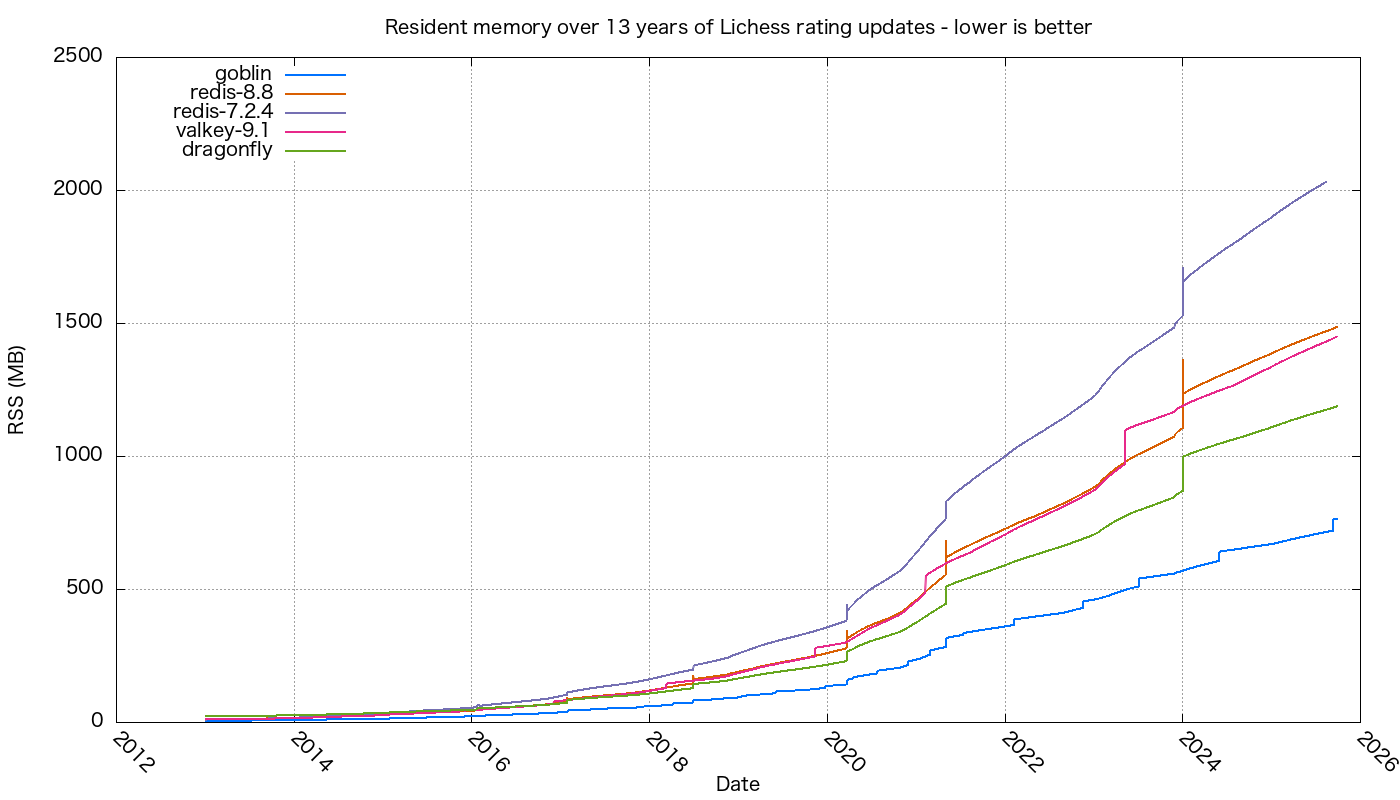
Goblin Core is the lowest line for the entire history. At the finish it uses:
- 48.6% less memory than Redis 8.8;
- 47.3% less than Valkey 9.1;
- 62.9% less than Redis 7.2.4; and
- 35.7% less than Dragonfly.
This is the memory result at the scale that matters: not an empty structure or a carefully selected million-member fixture, but a leaderboard after billions of real updates. Goblin holds all 21.6 million players in 763.8 MB, about half the resident memory of current Redis and Valkey.
The shape of the graph matters too. The Redis-family lines rise in allocator and rehash steps. Goblin's packed representation stays below them as the population and update history grow. The separation is structural, not a favorable reading taken at one endpoint.
Correctness: the same leaderboard
A smaller result is useless if it is the wrong result. After the feed completed, the harness exported the entire sorted set from Goblin Core and Redis 8.8 using ZRANGE leaderboard 0 -1 WITHSCORES and compared the outputs.
zset check: goblin 'leaderboard' MATCHES redis-8.8 (21598007 members)The member count, ordering, and scores matched across all 21,598,007 players. The memory comparison is therefore between two representations of the same final leaderboard, produced by applying the same updates in the same order.
Speed, including the Dragonfly result
Goblin completed the feed in about 41.3 hours. It was 7.7% faster than Redis 8.8, 6.8% faster than Valkey 9.1, and 21.6% faster than Redis 7.2.4. The memory advantage did not require giving up throughput relative to the Redis-family engines.
Dragonfly was faster: it completed in 85,545.937 seconds, about 1.74x faster than Goblin. That result should not be hidden. Dragonfly is designed to spread work across threads, while Goblin Core's result is the compact, single-engine path this benchmark set out to measure. If feed completion time is the only constraint, Dragonfly wins this run. If resident memory is the constraint, Goblin uses 424 MB less even after the full replay.
There is also a useful human scale for the absolute speed. The trace covers 4,656 elapsed days of play. Goblin replayed those years in 148,604.246 seconds: 2,707x faster than the games happened in real time. Even while trailing Dragonfly, Goblin can rebuild nearly thirteen years of leaderboard history in less than two days.
What was measured
The source game records were processed chronologically. For each game, every valid White or Black rating became a dated (player, rating) event. Those events were then streamed as individual ZADD commands. At the end of each date, after the preceding commands and replies had drained, the stream requested an INFO memory sample. This gave one at-rest memory observation per day rather than a measurement distorted by queued input or output buffers.
The benchmark harness started each server on its own Unix-domain socket and ran the five feeds in parallel. Persistence was disabled. Redis and Valkey ran with active defragmentation enabled and aggressive thresholds so long-lived allocator fragmentation was reclaimed rather than left as an avoidable handicap. Dragonfly ran with one proactor thread for the same serving-thread comparison used by the other Goblin Core benchmark reports.
The reported table uses the operating system's process RSS after the complete load. During the replay, both self-reported used_memory_rss and OS RSS were collected so their agreement could be checked.
Why the RSS reporting was patched
The benchmark originally uncovered a measurement problem in the Redis-family servers. Their INFO memory output could report a resident set below the RSS observed by ps, while Goblin and Dragonfly already agreed with the operating system. Leaving that discrepancy in place would have made Redis and Valkey look smaller than they really were.
Two reporting issues compounded:
used_memory_rsscame from a value cached by the server cron loop, refreshed roughly every 100 ms. ReadingINFOimmediately after a burst could therefore return a pre-burst value.- On the benchmark Linux kernel, the
/proc/self/statfield used by the Redis-family RSS reader was systematically below/proc/self/statusVmRSS,/proc/self/statmresident pages, andps -o rss.
For the isolated benchmark builds only, Redis 7.2.4, Redis 8.8, and Valkey 9.1 were changed to refresh the RSS value when building INFO memory and to read resident pages from /proc/self/statm. The corresponding allocated-memory fields were refreshed at the same instant so fragmentation ratios remained meaningful.
The effect was limited to reporting. No allocator, command implementation, storage structure, server configuration, or data path was changed. Goblin Core and Dragonfly were not patched. With the fixes, used_memory_rss, VmRSS, and the harness's ps reading agreed on the resident-memory metric used in the table.
The direction of the correction is important: it raised the Redis-family numbers to the operating system's actual resident set. It did not create Goblin's memory advantage; it removed an artificial advantage from the incumbents.
Reproducing the feed
The benchmark driver is benchmarks/feed_payload_uds.sh. It launches the engines, streams a chronological command payload, records daily memory samples and final OS RSS, exports the completed leaderboard, and performs the Goblin-versus-Redis correctness comparison.
The Lichess database is large and continues to grow, so an exact reproduction must use the same date range: 2012-12-31 through 2025-09-30. Each input game must preserve chronological order and emit the White and Black player rating observations independently. Changing the date range changes the number of games, players, and updates and is a new benchmark rather than a reproduction of this one.
For controlled per-operation comparisons and full host configuration, see BENCHMARKS. For a shorter explanation of why Goblin's sorted-set representation stays compact, see blogs/lichess-leaderboard.