Wikimedia replay: 80.8 million page counts in 1.63 GiB
September 22, 2026. Score run-length encoding (RLE) reduced the final RSS of the Wikimedia INT32/FLOAT32 packed zset from 2.089 to 1.626 GiB, saving 22.19% while replay time increased by 0.32%. That set contains 80,798,328 page IDs after 1,483,700,913 edit-count increments.
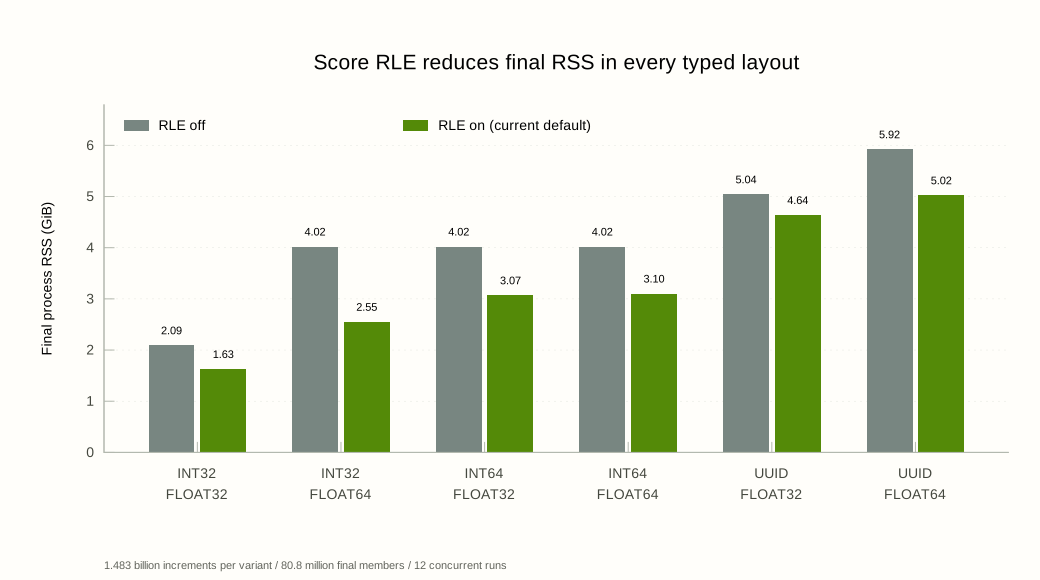
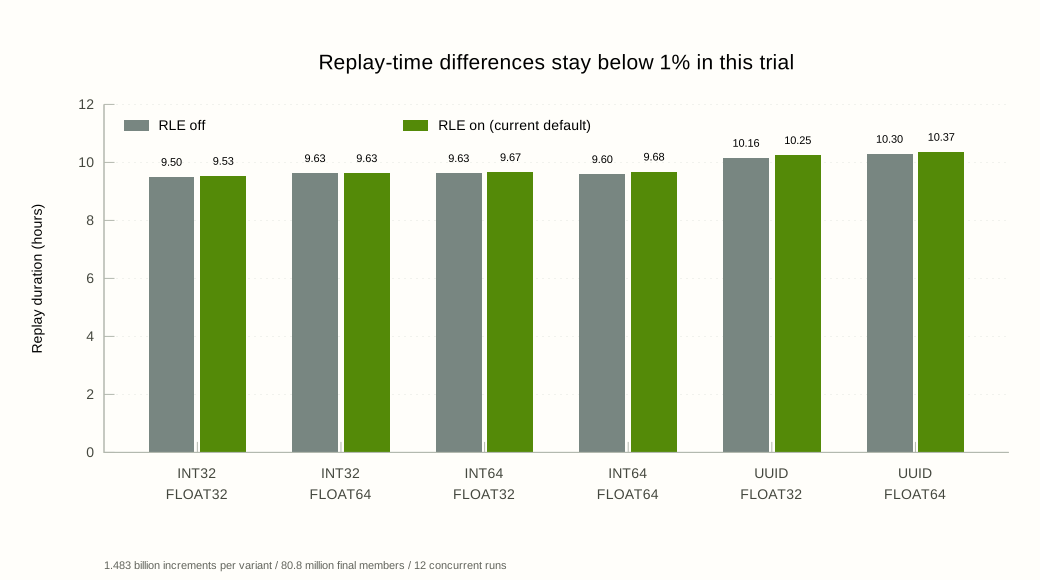
All 12 typed-layout/RLE combinations passed the full replay on naamah. Across all six layouts, RLE saved 8.08–36.52% of final process RSS, with measured replay-time increases of 0.03–0.92%. Score RLE is now on by default for typed packed zsets, with a command-line opt-out. These timings come from one concurrent trial per variant; differences below 1% are not established performance regressions without repeated trials.
The complete job, including verification and input checksum checks, finished at 10:42:37 a.m. EDT (14:42:37 UTC). All benchmark servers exited after verification. The controller recorded JOB-PASS and exit status zero.
Memory as entries are added
The new packed RLE result improves on both earlier Goblin representations and the incumbents in the verified full replays. At the same final state, it uses 22.64% less RSS than our earlier packed result, 53.00% less than standard Goblin, and 64.12–78.47% less than Dragonfly, Valkey, and Redis.
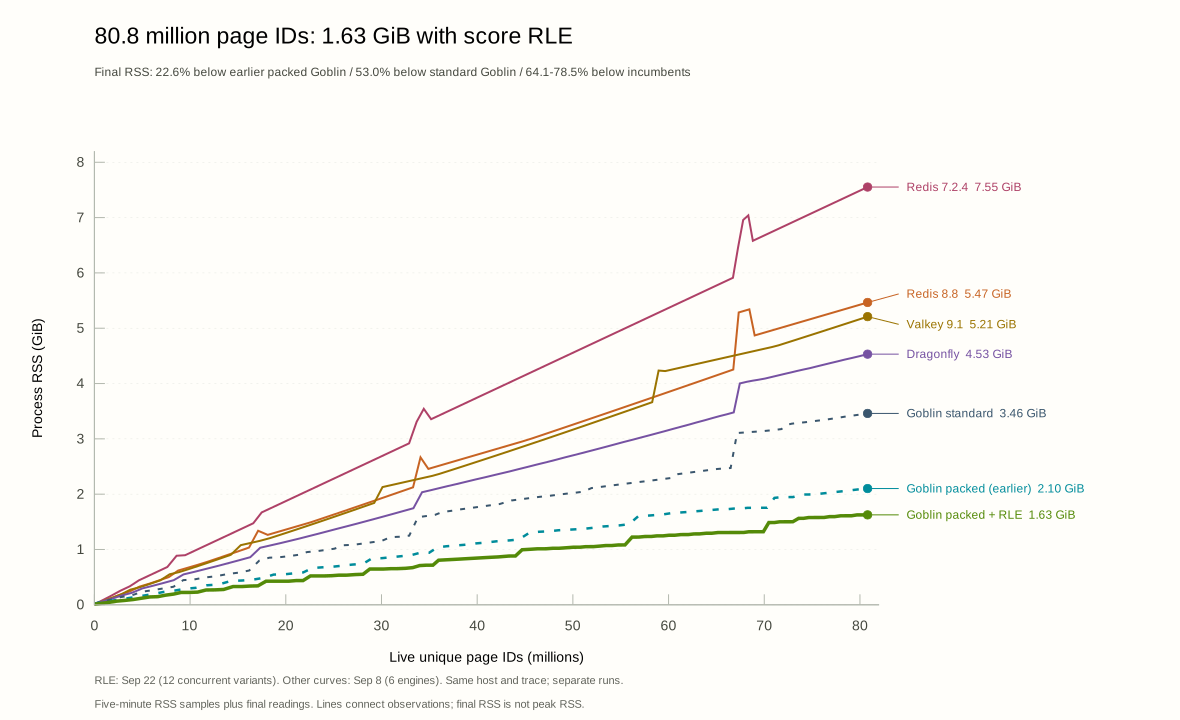
The horizontal axis is live unique page IDs, measured with ZCARD; repeated increments update existing members. The vertical axis is whole-server process RSS, sampled approximately every five minutes and at completion. Lines connect the recorded observations, preserving allocation jumps and drops. They do not capture unsampled peaks. All curves finish with the same verified mapping of 80,798,328 page IDs to edit counts.
The RLE curve comes from September 22, and the earlier Goblin and incumbent curves come from September 8. Both used naamah, the identical frozen numeric command trace, ordinary reply-per-command Unix-socket clients, and final RSS before verification without forced compaction. They are separate runs: September 8 ran six engines concurrently; September 22 ran twelve typed-layout variants. The incumbents were not rerun on September 22. The packed curves use INT32 members and FLOAT32 scores; standard Goblin and incumbents retain their general member representations. The chart compares the recorded memory growth at similar cardinalities; it does not compare speed between the runs.
| Representation | Measurement | Final RSS (GiB) | Less RSS with new RLE |
|---|---|---|---|
| Goblin packed + RLE | Sep 22 | 1.626 | — |
| Goblin packed, RLE off | Sep 22, paired control | 2.089 | 22.19% |
| Goblin packed, earlier result | Sep 8 | 2.102 | 22.64% |
| Goblin standard | Sep 8 | 3.459 | 53.00% |
| Dragonfly, one proactor | Sep 8 | 4.531 | 64.12% |
| Valkey 9.1 | Sep 8 | 5.209 | 68.79% |
| Redis 8.8 | Sep 8 | 5.465 | 70.25% |
| Redis 7.2.4 | Sep 8 | 7.552 | 78.47% |
The September 22 RLE-off control finishes within 0.6% of the earlier packed footprint. Its 22.19% paired reduction provides the comparison that isolates the RLE selection in the current build. The chart uses the earlier packed curve to show the progression from the original six-engine study; the same-run control is included in the table and the six-layout comparison below.
Plot data and source hashes include every plotted sample and the separately recorded final RSS readings. The original six-engine report retains its full configuration and verification evidence.
Using the improved options
For this dataset, select INT32 members and FLOAT32 scores:
goblin-core --zset-implementation packed-int32-float32This enables score RLE and uses merge exponent 0.5. Page IDs in the trace fit signed INT32, and the largest score, 2,162,914, is below FLOAT32's exact integer limit of 2²⁴. Ordinary ZINCRBY, ZRANGE, and other supported Z* commands operate on the selected typed representation. The other selectors are packed-int32-float64, packed-int64-float32, packed-int64-float64, packed-uuid-float32, and packed-uuid-float64; each enables RLE by default. The server's representation selector still defaults to standard when no packed layout is requested.
To explicitly select either score-storage mode:
goblin-core --zset-implementation packed-int32-float32 --packed-zset-score-rle
goblin-core --zset-implementation packed-int32-float32 --no-packed-zset-score-rle
The measured executable passed these flags explicitly for each variant. The new default selects the same RLE implementation; the measurements below retain the frozen benchmark's executable and provenance. Only merge exponent 0.5 was measured in this matrix. RLE policy also applies to typed command families, copies, aggregate-store destinations, and snapshot restoration; snapshots use the receiving server's setting.
Runs of four or more equal scores occupy three score-width words: [NaN marker, unsigned count, score]. Member IDs remain individually stored. Dirty updates retain their separate tuple storage, and logical rank, ordering, and leaf capacity are preserved. Scores with few ties benefit less and can pay extra buffer/checkpoint overhead. The opt-out supports comparisons on those workloads. See packed zset storage and limits.
Final process memory
RSS was recorded immediately after each feed drained, before verification. All endpoints contain the same verified logical state. GiB means 2³⁰ bytes.
| Member / score layout | RLE off RSS (GiB) | RLE on RSS (GiB) | RSS saved | Object allocation saved |
|---|---|---|---|---|
| INT32 / FLOAT32 | 2.089 | 1.626 | 22.19% | 22.68% |
| INT32 / FLOAT64 | 4.022 | 2.553 | 36.52% | 37.03% |
| INT64 / FLOAT32 | 4.022 | 3.067 | 23.74% | 24.33% |
| INT64 / FLOAT64 | 4.022 | 3.104 | 22.81% | 23.25% |
| UUID / FLOAT32 | 5.043 | 4.636 | 8.08% | 8.44% |
| UUID / FLOAT64 | 5.922 | 5.024 | 15.15% | 15.56% |
Object allocation is the separate GOBLIN.MEMORY total_allocated_bytes counter, not process RSS. In the original Wikimedia INT32/FLOAT32 layout, it fell from 2.034 to 1.573 GiB. Used sorted-base score storage fell from 312.069 to 3.393 MiB, with compressed score runs in 288,444 of 288,451 leaves. The score-storage reduction alone is not the whole-object or process saving.
No final compaction was forced. Final RSS excludes replay clients and the filesystem page cache, and is not peak RSS. Physical sorted/dirty record counts include deferred update state; final live cardinality comes from the verified 80,798,328-member result.
Replay times
Times below include the ordinary reply-per-command client, protocol, and reply drain. They exclude startup, input preparation, final verification, and cleanup. Durations are rounded to seconds; percentages use raw times.
| Member / score layout | RLE off (h:mm:ss) | RLE on (h:mm:ss) | RLE time increase |
|---|---|---|---|
| INT32 / FLOAT32 | 9:30:11 | 9:32:02 | 0.32% |
| INT32 / FLOAT64 | 9:37:47 | 9:37:59 | 0.03% |
| INT64 / FLOAT32 | 9:37:50 | 9:39:56 | 0.37% |
| INT64 / FLOAT64 | 9:35:56 | 9:40:46 | 0.84% |
| UUID / FLOAT32 | 10:09:20 | 10:14:57 | 0.92% |
| UUID / FLOAT64 | 10:17:51 | 10:21:58 | 0.67% |
All 12 ran concurrently from empty sets on the same Threadripper PRO 5995WX host (64 cores / 128 threads, approximately 991 GiB RAM), without CPU pinning. They used the same frozen Release executable, merge exponent 0.5, one Unix socket and one redis-cli client each, and explicit RLE on/off flags. Five-minute RSS samples and final compression counters are archived.
UUID members are zero-extended numeric page IDs, generated before timing. Their input file is longer (75.67 GB versus 33.25 GB), so cross-layout timings include a wire-size difference. Compare RLE within each layout. Comparisons with the September 8 study would also mix different executable builds and different numbers of concurrent clients. The earlier six-engine comparison retains the standard Goblin, Redis, Valkey, and Dragonfly results from that run.
Correctness and timeline
The controller first verified a two-million-command prefix against an independent Python count of the source commands. All 12 passed that gate. The full feeds began at 04:10:53 UTC. The last feed finished at 14:32:51 UTC, and the final comparison was generated at 14:38:21 UTC. Input rehashing and controller completion finished at 14:42:37 UTC.
Full-state verification read every member in 65,536-member rank pages after all feeds completed. Every variant matched the previous verified full-run numeric reference, including ordered SHA-256 and all mapping fingerprints. UUIDs were decoded back to numeric page IDs before comparison. Every result had integral scores, zero ordering violations, score sum 1,483,700,913, member range 0–84,112,066, and score range 1–2,162,914. These scores remain exactly representable as FLOAT32 integers.
All replay and digest error logs are empty; every digest pipeline exited 0 0. The final score_rle counters matched their requested flags. Both frozen input SHA-256 hashes matched their preflight values after the replay. The copied local evidence was rechecked for matching input records, harness hashes, flags, statuses, and all twelve final digests.
Evidence
- Raw per-variant measurements
- Generated comparison with compression counters
- Full verification output
- Evidence bundle and provenance
- Launch configuration and hashes
- Memory growth samples, final comparisons, and source hashes
The charts are generated from the archived summaries and sample series by python3 benchmarks/wikimedia_history_2026_08/plot_rle_comparison.py (requires Gnuplot). All three SVGs are standalone vector artifacts; all chart axes start at zero, and the tables preserve the more precise measurements.
Remote project: /home/adam/wiki2/wikimedia-rle-matrix-20260922T035401Z on naamah. Local complete result snapshot: benchmark-results/wikimedia-rle-matrix-20260922T035401Z/remote-completed. The large input files, executable, and build remain on the remote host.