14.3 billion chess games in one leaderboard
A chess rating is a sorted set. Every rated game on Lichess nudges a player up or down a leaderboard — which is exactly ZADD leaderboard <new-rating> <player>. So we took the real thing: every rated game in Lichess's public history — 14.3 billion of them, one ZADD each, across 21,598,007 players and 4,657 days (12 years and 9 months) of play — and replayed the whole trace into a single sorted set, on five engines at once.
The workload is nothing but ZADD re-scores of players who already exist, with narrow chess-rating scores (~1000–2000), pipelined in blocks of 128 and streamed over a UNIX-domain socket with redis-cli. We ran goblin-core against Redis 7.2.4, Redis 8.8, Valkey 9.1, and Dragonfly — all in parallel on one host, each tuned to its best (active defrag on for the Redis family, persistence off). The fair-measurement details, including RSS-reporting bugs we fixed in the incumbents against our own favour, are in LICHESS-BENCHMARK.
And it is the same leaderboard: at the end we diffed goblin's ZRANGE leaderboard 0 -1 WITHSCORES against Redis 8.8's, member for member, score for score. Identical, across all 21,598,007 players.
Results
| server | redis-cli (s) | os_rss (MB) |
|---|---|---|
| goblin | 148,604 | 763.8 |
| redis-8.8 | 160,092 | 1,486.7 |
| redis-7.2.4 | 180,710 | 2,058.6 |
| valkey-9.1 | 158,637 | 1,450.7 |
| dragonfly | 85,546 | 1,187.8 |
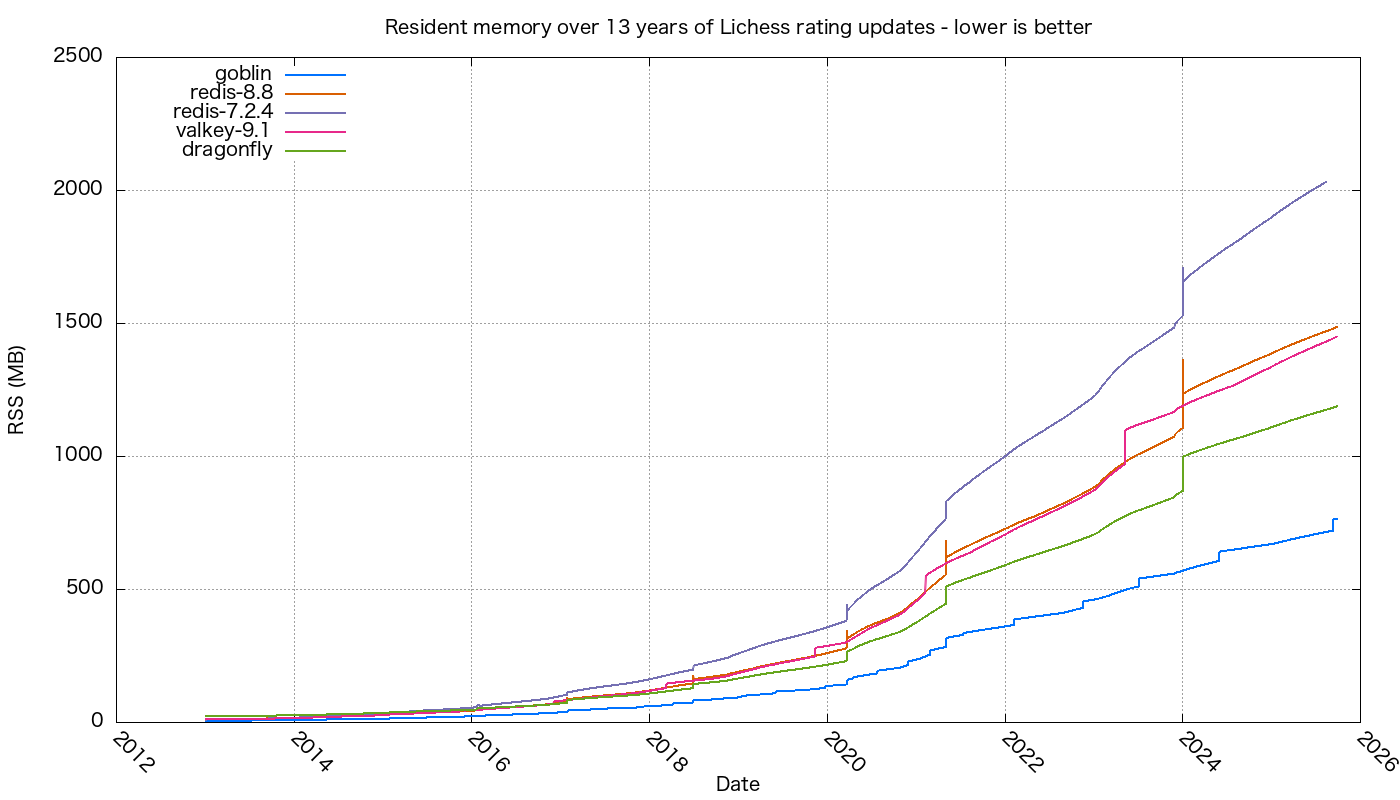
Memory is the story
That chart is the whole point, and it holds for the entire replay: goblin is the leanest line at every single date, and the gap only widens as the leaderboard grows. At the finish it holds all 21.6 million players in 763.8 MB — about half of Redis 8.8 and Valkey, 37% of legacy Redis 7.2.4, and 64% of Dragonfly.
Look at the shape, too. The Redis-family curves climb in sharp vertical steps — jemalloc grabbing new arenas, rehashes reallocating, active-defrag churning — while goblin's line rises smoothly and stays flat between growth. Same data; a fundamentally different memory profile. That is the result: for a workload that is nothing but sorted-set writes, goblin needs roughly half the RAM of the engines it drops in for.
On speed
Speed is not the headline, and we won't dress it up. On feed time goblin came in a little ahead of the Redis family — 148,604 s against 158,637 for Valkey, 160,092 for Redis 8.8, and 180,710 for Redis 7.2.4 — and behind Dragonfly's 85,546 s, which spreads its work across threads. A modest edge over the engines it replaces, a real gap to Dragonfly. The client was not the bottleneck; these are the servers' own numbers. The point is that the memory win costs nothing in throughput: you halve the resident set without falling behind the engines you are replacing. For head-to-head throughput on isolated micro-benchmarks, see BENCHMARKS.
In absolute terms the run was quick regardless: goblin replayed 4,657 days of rating history in about 41 hours, roughly 2,700 times faster than the games were actually played.
Why the sorted set is so lean
A Redis sorted set is a skip list — members chained in score order through a tower of forward pointers, one node per member with (on average) about 1.3 levels of pointers each — paired with a hash table mapping member to score. It is fast, but every member carries a fistful of 8-byte pointers, and the skip-list nodes and dict entries are separate heap allocations that fragment over time.
goblin keeps the same two abilities — ordered-by-score, and member to score — but pays far less for them:
- Small sorted sets are a single allocation. Below a threshold the whole set is a compact listpack: count, score width, and length live in an 8-byte header, and members sit back-to-back as
[len][score][bytes], sorted by (score, member). The store holds one tagged pointer per key — no per-element nodes at all. - Large sorted sets are a chunked sorted list, not a skip list. The score order lives in contiguous blocks of about 256 entries; each entry is just 16 bytes — a
doublescore, a 32-bit member id (not a pointer), and the first four bytes of the member name inlined as a tie-break accelerator so ordering rarely has to chase the name. The member bytes live once, in a packed arena, addressed by that 32-bit id. Finding a score is a search to the right block and then within it; there are no per-node level pointers to store or to fragment.
That is where half the memory comes from: ids instead of pointers, blocks instead of nodes, one arena instead of millions of tiny allocations — and, because it is contiguous, it stays flat and defrag-free as the leaderboard grows to 21.6 million players. This run is that claim at 14-billion-write scale.
---
See BENCHMARKS for the controlled micro-benchmarks, and LICHESS-BENCHMARK for how the memory was measured fairly.